
.png)
.png)
.png)





Thermal Scope Lens Size: 25mm vs 35mm vs 50mm Explained
When choosing a thermal scope for hunting, lens size is a key specification to consider. Common lens sizes include 25mm, 35mm, and 50mm. This number refers to the lens's approximate focal length, which has a major influence on field of view and magnification, and therefore affects how the scope performs at different hunting distances.
A larger lens is not necessarily better. The 50mm thermal scope may be more suitable for long-range observation, while the 25mm model is easier to use when the target is closer. The right choice depends on your hunting distance, target size, terrain, and viewing habits.
What Does Thermal Scope Lens Size Mean?
When people talk about a 25mm, 35mm, or 50mm thermal scope, they are usually referring to focal length.
Focal length affects two key aspects: the field of view and image magnification.
A shorter focal length, such as 25mm, generally gives a wider field of view. This makes it easier to scan an area and follow moving targets.
A longer focal length, such as 50mm, generally provides a narrower field of view and more apparent magnification. It is better suited to examining distant targets.
The 35mm specification falls somewhere in between, offering a more balanced viewing experience.
25mm Thermal Scope: Wider Field of View, Greater Flexibility
For hunters operating at close to medium ranges, a 25mm thermal imaging scope is often a practical choice.
Its wider field of view makes it easier to locate animals, especially when they are moving across the scene. This advantage is particularly significant in environments such as forests or dense brush, where targets may appear suddenly.
A wider view also makes it easier to keep a moving animal in the image.
For hunters who do not require frequent long-range observation, a 25mm thermal scope can provide a comfortable combination of viewing area and usability.
35mm Thermal Scope: A Balanced Choice
A 35mm thermal imaging scope offers a balance between field of view and magnification.
Compared to a 25mm lens, it offers a longer detection range, yet provides a wider field of view than many devices equipped with 50mm lenses. This makes it a versatile and practical choice for hunters who frequently encounter varying shooting or observation distances.
For example, a hunter may use the same scope in woodland one weekend and a more open field the next.
If you want clear target detail without sacrificing too much of your field of view, a 35mm thermal scope is an ideal choice.
50mm Thermal Scope: More Reach for Distant Targets
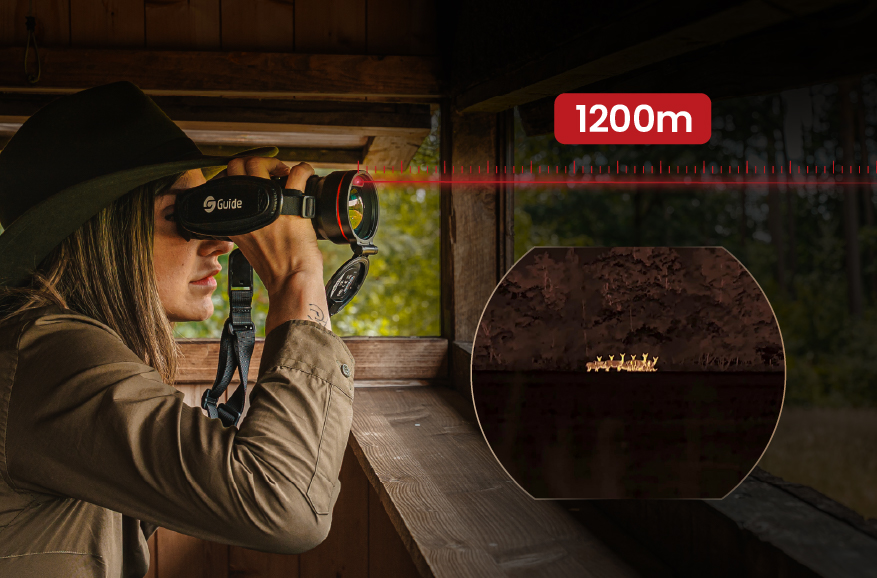
A 50mm thermal scope generally provides a narrower field of view and higher image magnification, making it easier to observe distant targets when paired with an appropriate thermal sensor.
A narrower field of view makes distant targets appear larger in the display, facilitating the identification and observation of heat signatures at long ranges.
This feature is particularly useful in open settings such as farmlands, grasslands, or other environments where animals may remain far away.
However, a narrower field of view can also make it difficult to spot or track moving targets. A 50mm scope is therefore not automatically the best option for every hunting environment.
25mm vs 35mm vs 50mm: Quick Comparison
Feature | 25mm | 35mm | 50mm |
Field of View | Wider | Medium | Narrower |
Apparent Magnification | Lower | Medium | Higher |
Close-Range Use | Excellent | Good | Less convenient |
Medium-Range Use | Good | Excellent | Very good |
Long-Range Observation | Limited | Good | Excellent |
Moving Targets | Easier to follow | Balanced | More difficult |
Dense Terrain | Often better | Versatile | More challenging |
Open Terrain | Good | Very good | Excellent |
This comparison shows why there is no universal “best” lens size.
How Lens Size Affects Hunting
The size of the lens influences how quickly you can spot game.
A thermal scope with a 25mm lens offers a wider field of view, making it easier to detect moving game.
In contrast, a 50mm lens provides a more focused view. Once the game has been located, this greater observation range allows for a more detailed look at the target.
The 35mm lens offers a middle ground and may be suitable for hunters who use their thermal scope across different distances.
Lens Size is Not the Only Factor to Consider
Do not judge a thermal imaging scope only by its lens size.
Sensor resolution is equally critical. A high-resolution sensor captures more image detail, while a high-quality lens ensures that information reach the sensor effectively.
Other specifications also influence performance, including thermal sensitivity, refresh rate, image processing capabilities, and display quality.
Pairing a 50mm lens with a low-quality sensor may not yield better performance than a 25mm lens equipped with a superior imaging system.
It is essential to evaluate the optical and thermal imaging system as a whole.
Which Lens Size Should Hunters Choose?
If you mainly hunt in woods, brush, or areas where targets are at close range, a 25mm thermal scope may be the better choice.
For hunters seeking a versatile device capable of handling close, medium, and long-range hunting, a 35mm thermal scope is a good option.
If your hunting activities focus mainly on long-range observation, then a 50mm thermal scope is the more logical choice.
The best choice should match the way you actually hunt rather than simply choosing the largest lens.
Conclusion
The differences between 25mm, 35mm, and 50mm thermal scope lenses lie mainly in their field of view, apparent magnification, and ease of observing targets at varying distances.
A 25mm lens offers a wider field of view, making it generally better suited for observing moving targets at close range; a 35mm lens provides a good balance between field of view and detection range; while a 50mm lens is more effective at detecting distant targets but provides a relatively narrower field of view.
For hunters, selecting the right lens size depends on factors such as hunting distance, terrain, target movement, and the rest of the thermal scope's specifications.












.png)

.png)
